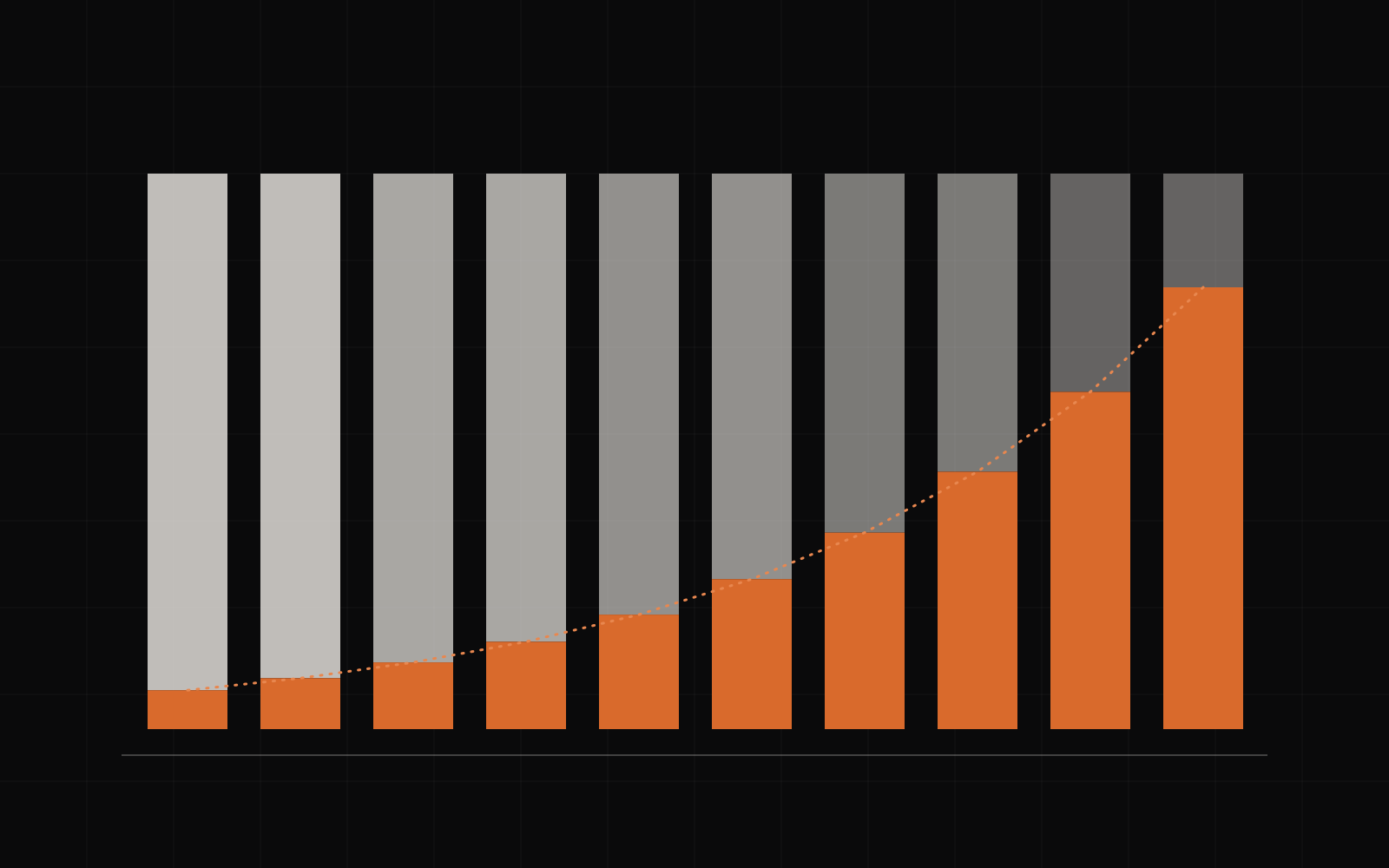
When a product underperforms, the post-mortem usually blames one of two things. The strategy was wrong: wrong market, wrong feature, wrong timing. Or delivery was poor: slow engineering, missed dates, quality problems.
The most common cause we see is neither. The strategy was reasonable and the team was capable. The value was lost in between, where direction is supposed to become a plan, and the plan is supposed to become working software that changes something the business can measure.
What the gap looks like
It’s rarely dramatic. It shows up as a series of small disconnections.
The goal gets lost in translation. Leadership wants to improve retention among new customers. By the time that reaches the team, it has become a list of features: a welcome sequence, a loyalty tier, push notifications. The features ship. Nobody checks whether retention moved.
Priorities multiply on the way down. The strategy names three priorities. Each department reads them through its own lens and pushes its own requests. The team ends up with fifteen priorities and no way to choose between them.
Constraints surface too late. The strategy assumed things about the platform that weren’t true, and engineering finds out mid-build, when the plan has to be reworked under time pressure.
Learning doesn’t travel up. The team discovers that a feature isn’t working, or that a simpler approach would reach the same result. That knowledge stays at team level, and leadership keeps steering by the original plan.
Nobody owns the whole line. Leadership owns strategy, engineering owns delivery, and product is supposed to connect them but is often too buried in tickets and requests to see the full picture.
Why it’s so common
The people who set strategy and the people who deliver it work at different altitudes, on different time horizons, with different information. Leadership thinks in quarters and years, about markets, revenue and competition. Delivery teams think in sprints, about tickets, defects and dependencies. Both views are necessary, and without someone actively translating between them, they drift apart.
In multi-brand, multi-market and regulated businesses, the distance is larger. There are more stakeholders, more constraints and more ways for one clear goal to split into conflicting requests.
Closing it
Keep the outcome attached to the work. Every item on the roadmap carries the goal it serves and the metric that shows whether it worked, all the way down to the ticket. When people can see what a task is for, they start asking whether it’s the best way to get there.
Translate strategy into a small number of bets. Don’t hand a strategy document to a delivery team. Turn it into a handful of bets for the quarter, each with a goal, a metric, a first solution and one owner. Bets are allowed to be wrong. That’s what makes them useful.
Test feasibility before committing. Bring engineering in while the direction is still flexible, so expensive assumptions are found in a meeting, not in month four.
Report results upward every month. The report covers what moved, what didn’t and what was learned, rather than status. Leadership then adjusts direction based on what’s actually happening.
Trust the team with the how. Once the goal and the measure are clear, let the people closest to the work decide how to get there. Expect clear reporting, and step in when something is actually off track. Micromanaging the middle of the line is one of the fastest ways to widen the gap.
Give someone ownership of the whole line. This is the role most often missing: one person accountable for the connection from strategic goal to measured result. In smaller companies it can be a senior product owner. In larger ones it’s a head of product, a product operations function, or a fractional product lead.
When it works
The first thing you notice is that roadmap meetings get shorter, because everyone is working from the same few goals. Good ideas also start surviving the trip from the strategy deck to the platform, or they get changed on purpose, based on evidence.
If your business has clear direction and a capable team, and the results still aren’t coming, look at the middle.